
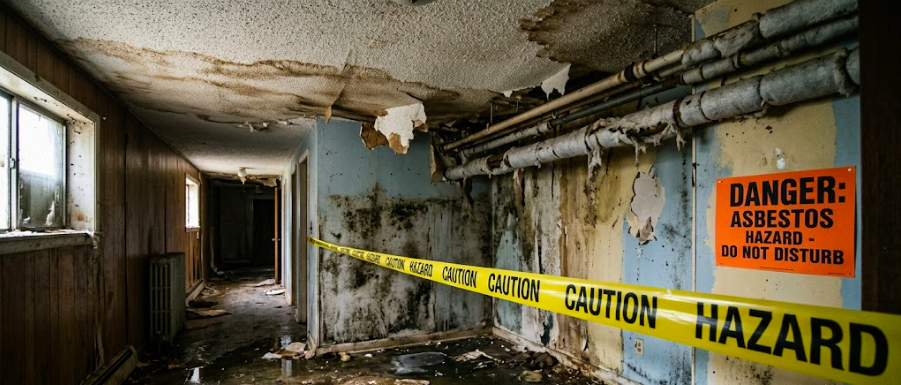
The Overlooked Danger: Water Damage and Asbestos
When a pipe bursts, a roof leaks, or a flood rushes through your home, the immediate panic centers on the visible destruction soaked carpets, swollen drywall, ruined furniture, and the frantic search for help. What rarely crosses a homeowner’s mind in those chaotic first hours is the invisible threat that water damage may have just unleashed: airborne asbestos fibers.
The connection between water damage and asbestos disturbance is one of the most underappreciated hazards in residential safety. Millions of American homes particularly those built before 1980 contain asbestos in dozens of common building materials. Under dry, undisturbed conditions, these materials are largely dormant and pose minimal risk. But introduce moisture, structural weakening, material degradation, or the physical impact of a water event, and the picture changes dramatically.
Water doesn’t just ruin your walls and floors. In older homes, it can turn building materials into friable (easily crumbled) asbestos hazards, releasing microscopic fibers into the air you and your family breathe.
This comprehensive guide explains the exact mechanisms by which water damage disturbs asbestos, identifies the most vulnerable materials in your home, covers the serious health consequences of exposure, and outlines what steps you must take to protect yourself whether you’re in New England, the Gulf Coast, or the Rio Grande Valley of South Texas.
“Water damage doesn’t just destroy what you can see. In homes built before 1980, a single flood event can transform a stable building material into an airborne asbestos hazard within hours.”
What Is Asbestos and Where Is It Found in Homes?
Asbestos is a group of naturally occurring silicate minerals prized for centuries and weaponized commercially throughout much of the 20th century for their extraordinary heat resistance, tensile strength, and insulating properties. Six types of asbestos minerals exist, but three were most commonly used in construction: chrysotile (white asbestos), amosite (brown asbestos), and crocidolite (blue asbestos).
From roughly the 1930s through the late 1970s, asbestos was a staple ingredient in hundreds of building products. It was cheap, fire-resistant, durable, and incredibly versatile. The Environmental Protection Agency (EPA) and the Consumer Product Safety Commission (CPSC) began restricting its use in the 1970s following mounting evidence of its catastrophic health effects, but the mineral was never fully banned in the United States meaning some asbestos-containing products are still manufactured today, and virtually every home built before 1980 contains it somewhere.
Common Locations of Asbestos in Residential Buildings
| Location / Material | Typical Use Era | Water Damage Risk |
|---|---|---|
| Pipe and duct insulation | 1920s–1970s | Very High |
| Popcorn / textured ceiling spray | 1950s–1980s | Very High |
| Vinyl floor tiles (9″×9″) | 1950s–1980s | High |
| Floor tile adhesive (mastic) | 1940s–1980s | High |
| Drywall joint compound | 1940s–1977 | Very High |
| Roof shingles and felt | 1930s–1980s | High |
| Exterior siding (transite) | 1930s–1970s | Moderate |
| Fireplace and boiler insulation | Pre-1980s | Very High |
| Acoustic ceiling tiles | 1950s–1970s | Very High |
| Plaster walls and ceilings | Pre-1940s | High |
| HVAC duct tape / gaskets | Pre-1980s | Moderate |
| Attic vermiculite insulation | 1950s–1990s | Very High |
One important distinction that professionals make is between friable and non-friable asbestos-containing materials (ACMs). Friable materials can be crumbled by hand pressure and readily release fibers. Non-friable materials are more tightly bound. Water damage can convert non-friable materials into friable ones which is precisely why even “safe” ACMs become dangerous after flooding or prolonged moisture exposure.
How Exactly Does Water Damage Disturb Asbestos?
The relationship between water damage and asbestos disturbance isn’t always immediately obvious. To understand it, you need to understand what holds asbestos fibers in place and what destroys that binding.
1. Physical Saturation and Material Breakdown
Many ACMs rely on a binding matrix cement, adhesive, or organic binders to hold asbestos fibers in place and prevent their release. When these materials become saturated with water, the binders weaken, swell, and begin to delaminate. Popcorn ceilings, for instance, are highly porous and can absorb substantial water from a roof leak or upstairs plumbing failure. As they saturate, the textured spray coating loses structural integrity, begins sagging, and eventually collapses releasing fibers directly into the living space below.
2. Mold Growth Accelerating Fiber Release
Water damage and mold growth go hand in hand, and mold presents a secondary threat to asbestos-containing materials. Mold colonies can colonize and biologically degrade organic binders in ACMs, further weakening the material matrix and accelerating the release of fibers. A home that has experienced water damage and subsequent mold growth in older ceiling tiles or insulation is doubly dangerous.
3. Structural Damage and Building Movement
Significant water events basement flooding, storm surges, or burst pipes that go undetected for days can cause structural settling, wood rot, and foundation movement. As the structural skeleton of a building shifts, it exerts stress on rigid materials containing asbestos (such as transite siding or asbestos-cement board) that were installed decades ago. This physical stress can fracture these materials, suddenly converting them from non-friable to friable ACMs.
4. The Drying Process: Equally Dangerous
Most people assume the danger peaks when water is present. In fact, the drying phase can be just as hazardous. As water-damaged ACMs dry out, they shrink, crack, and crumble. Rapid evaporation especially when fans or industrial drying equipment are used without first testing for asbestos can aerosolize fibers that would otherwise have remained bound in the material. Professional water damage restoration companies that fail to conduct asbestos screening before deploying high-velocity air movers can inadvertently contaminate an entire home.
5. Remediation Activities That Disturb ACMs
This is perhaps the most preventable pathway to asbestos exposure during a water damage event. Well-meaning homeowners or inexperienced contractors who begin demolishing water-damaged ceilings, pulling up vinyl floor tiles, or cutting through drywall to assess structural damage can disturb ACMs without any idea they’re doing so. In older homes, this kind of “demo work” represents one of the highest-risk scenarios for acute asbestos fiber release.
Do Not Do This
Never cut, sand, drill, scrape, or demolish any building material in a pre-1980 home affected by water damage before getting an asbestos inspection. The EPA estimates that approximately 35 million homes in the U.S. contain some form of asbestos-containing material, and disturbing them without proper precautions is a federal violation under NESHAP (National Emission Standards for Hazardous Air Pollutants).
High-Risk Asbestos-Containing Materials After Water Damage
While any ACM in your home can be affected by water, certain materials carry a disproportionately higher risk of releasing fibers following a water event. Here’s what to watch for:
Popcorn / Textured Ceilings
Spray-applied textured ceilings commonly called “popcorn ceilings” or “acoustic ceilings” were ubiquitous in homes and apartments built from the 1950s through the mid-1980s. These products frequently contained up to 10% chrysotile asbestos by composition. They are among the most friable ACMs in existence under any conditions, and water saturation makes them catastrophically unstable. A ceiling leak of even modest severity can cause a popcorn ceiling to collapse, releasing a dense cloud of asbestos fibers into the room below.
Pipe Wrap and Boiler Insulation
Older homes and apartment buildings often have plumbing pipes and HVAC ducts wrapped in asbestos-containing insulation typically a corrugated cardboard-like material or a white chalky lagging. This material is already among the most friable ACMs found in buildings. When exposed to moisture from a burst pipe or plumbing leak in the immediate vicinity, it degrades rapidly and can shed enormous quantities of fibers. The insulation around the very pipe that fails may be the first material affected.
Vinyl Floor Tiles and Mastic Adhesive
The classic 9-inch-by-9-inch vinyl tiles popular from the 1940s through the 1970s almost universally contained asbestos in the tile body and in the black tar-like mastic adhesive beneath them. When flooding occurs, sustained water exposure weakens the adhesive bond, causing tiles to lift, buckle, and break. Broken or crumbled 9×9 tiles are a significant asbestos exposure concern. The mastic beneath intact tiles also contains asbestos and is highly friable when dry and crumbling a condition that can develop after the wetting-and-drying cycle of a flood.
Drywall and Joint Compound
Drywall joint compound (topping compound, taping compound, and texture compound) manufactured before 1977 commonly contained asbestos. The paper facing of drywall panels can absorb moisture rapidly, causing the compound to swell and de-bond from the substrate. During demolition of water-damaged walls — even well-intentioned, necessary demolition the sanding and cutting of old joint compound generates some of the highest asbestos fiber concentrations measurable in a residential setting.
Attic Vermiculite Insulation
An estimated 35 million homes in North America received vermiculite attic insulation between the 1950s and 1990s, most of it from the W.R. Grace Zonolite mine in Libby, Montana, which was heavily contaminated with tremolite asbestos. Attic leaks, roof damage from severe weather, and ice dams are common scenarios in which water intrudes into attic spaces and contacts vermiculite. Wet vermiculite that is subsequently disturbed during post-storm inspection, insulation removal, or attic conversion projects can release tremolite fibers, which are among the most toxic asbestos fiber types.
Health Risks: Why Disturbed Asbestos Is Deadly
The reason asbestos is treated with such extraordinary regulatory caution comes down to the unique physical properties of its fibers. Asbestos fibers are microscopic most invisible to the naked eye and their needle-like shape makes them both aerodynamically persistent (they remain airborne for hours) and biologically devastating once inhaled.
When asbestos fibers are inhaled, they penetrate deep into lung tissue, where they cannot be broken down or expelled by the body’s natural defense mechanisms. Over time, the accumulated fibers cause progressive scarring, inflammation, and genetic damage that manifests as serious, often fatal diseases typically with a latency period of 15 to 50 years between exposure and diagnosis.
- Mesothelioma: A rare and aggressive cancer of the mesothelial lining of the lungs, heart, or abdomen. Asbestos exposure is the only known cause. Median survival after diagnosis is 12–21 months. There is no cure.
- Asbestos-related lung cancer: Asbestos exposure significantly increases the risk of lung cancer, particularly in smokers. The synergistic risk between asbestos and tobacco can be as high as 50–90 times the baseline risk.
- Asbestosis: Chronic, progressive scarring of lung tissue (pulmonary fibrosis) caused by accumulated asbestos fibers. Causes severe, permanent breathing impairment. No treatment reverses the scarring.
- Pleural disease: Plaques, thickening, and effusions (fluid accumulation) affecting the pleural membrane surrounding the lungs, causing chronic pain and reduced respiratory function.
- Laryngeal and ovarian cancer: The IARC (International Agency for Research on Cancer) has classified asbestos as a Group 1 carcinogen also associated with these cancers.
There is no established “safe” threshold for asbestos exposure. Even brief, one-time exposures during a water damage remediation event can theoretically initiate the disease process. This is why environmental health authorities and OSHA are unequivocal: any suspected asbestos disturbance must be treated as a serious health emergency.
Concerned About Asbestos After Water Damage?
East Coast Asbestos provides certified asbestos inspections, testing, and abatement coordination across the East Coast and beyond. Our AHERA-certified inspectors will identify every ACM in your home before remediation begins. Schedule a Free Consultation →
Special Concern: McAllen, TX and the Rio Grande Valley
GEO Focus: South Texas / McAllen / Rio Grande Valley
Homeowners in McAllen, Edinburg, Mission, Pharr, Harlingen, Brownsville, and the broader Rio Grande Valley face a particularly high-risk combination of aging housing stock and extreme weather events that make the water damage–asbestos connection especially urgent.
- McAllen and surrounding RGV cities experienced rapid residential construction booms during the 1950s–1970s, when asbestos use was at its peak. Tens of thousands of ranch-style homes in the area contain asbestos in ceilings, floors, and insulation.
- South Texas’s subtropical climate brings intense seasonal thunderstorms, flash flooding, and hurricane-related rain events (from the Gulf of Mexico) that regularly cause roof damage, basement intrusion, and interior flooding.
- The region’s high humidity accelerates mold growth in water-damaged ACMs, compounding the fiber-release risk described earlier in this guide.
- Older plumbing infrastructure in McAllen’s established neighborhoods is prone to corrosion-related pipe failures that can go undetected for days saturating walls and ceilings.
If you’ve experienced water damage in a McAllen home built before 1980, the combination of risks is serious enough to warrant professional evaluation before any restoration or demolition work begins. Fortunately, South Texas has professional water damage restoration services that understand this dynamic.
We recommend working with a licensed water damage restoration company that explicitly follows EPA asbestos pre-screening protocols before beginning demolition or drying activities. For residents in the McAllen area, McAllen TX Water Damage Restoration provides emergency water damage services and understands the local landscape of pre-1980 construction making them an important first call when a water event strikes. A coordinated approach between water restoration professionals and a certified asbestos inspector is the safest path forward for RGV homeowners.
Hurricane and Storm Risk in the Rio Grande Valley
South Texas sits in an active hurricane corridor. The lower Rio Grande Valley has been affected by multiple tropical systems over the past three decades, including tropical storms and hurricanes that bring sustained heavy rainfall, storm surge, and roof damage to thousands of homes simultaneously. When a major weather event affects the McAllen metro area, the demand for emergency water damage response surges and the pressure to begin rapid restoration can lead to shortcuts, including skipping asbestos pre-screening.
Local and regional contractors who service storm-damaged homes in Hidalgo County, Cameron County, and Starr County must be familiar with EPA NESHAP regulations requiring asbestos surveys before renovation or demolition of structures that may contain ACMs. Homeowners should ask any contractor arriving after a storm: “Has this home been tested for asbestos before you begin work?” If they cannot confirm pre-screening, request it before work begins.
Warning Signs Your Water-Damaged Home May Have Asbestos
Most asbestos cannot be identified by sight alone laboratory analysis of a physical sample is the only definitive method. However, certain observable characteristics of your home and its building materials can alert you to elevated likelihood of ACM presence after a water event.
- Home was built before 1980: The single most reliable indicator. If your home predates EPA restrictions, assume ACMs are present until testing proves otherwise.
- Textured ceilings are sagging or falling: Water-saturated popcorn ceilings that are visibly drooping or have collapsed into a room should be treated as an asbestos emergency.
- Small square floor tiles (9″×9″): If your home has small vintage vinyl tiles especially in kitchens, bathrooms, or basements and they are lifting, cracking, or breaking after flooding, assume asbestos until tested.
- Insulation wrapped in white, grayish, or corrugated material: Pipe lagging or duct insulation with this appearance in older homes is highly suspect. Do not touch or disturb.
- Gray or silver-colored tape on HVAC ducts: Old duct tape from pre-1980 installations often contained asbestos fibers. Water exposure can cause it to peel and release fibers.
- Water-damaged walls in pre-1977 construction: Drywall and plaster installed before 1977 may contain asbestos in the compound and texture coats.
- Gray-silver granular attic insulation: This is classic vermiculite insulation and must be treated as presumptively asbestos-contaminated.
- Dark, tar-like residue beneath old flooring: Black mastic adhesive beneath vinyl or linoleum flooring from pre-1980 eras commonly contained asbestos.
What to Do If You Suspect Water-Disturbed Asbestos
If you’ve experienced water damage in a pre-1980 home and have any reason to believe asbestos-containing materials have been wetted, disturbed, or damaged, follow these steps in order:
- Evacuate the affected area immediately. Do not re-enter the room where ACMs may have been disturbed until it has been professionally assessed. If the disturbance appears significant (a ceiling collapse, for example), consider temporarily relocating your household.
- Do not run fans, HVAC systems, or air movers. Circulating air will distribute asbestos fibers throughout your home. Shut off all forced-air systems and close interior doors to limit fiber migration.
- Do not attempt to clean up debris. Household vacuums including HEPA vacuums used for general cleaning are not rated for asbestos fiber capture. Sweeping or wet-mopping asbestos debris without proper equipment can intensify fiber release.
- Contact a certified asbestos inspector. Look for inspectors holding AHERA (Asbestos Hazard Emergency Response Act) certification or state-issued asbestos inspector licenses. They will collect physical samples of suspect materials and submit them to an accredited laboratory for PLM (Polarized Light Microscopy) or TEM (Transmission Electron Microscopy) analysis.
- Contact a licensed water damage restoration company. Choose one that explicitly conducts asbestos pre-screening or coordinates with asbestos professionals before beginning demolition or drying. For South Texas residents, McAllen TX Water Damage Restoration services the Rio Grande Valley with emergency response capabilities and awareness of local construction-era hazards.
- Document everything for insurance purposes. Photograph all water-damaged areas and any suspected ACMs before any cleanup begins. Most homeowner’s insurance policies cover asbestos abatement when it is necessitated by a covered water damage event but claims require documentation.
- Notify your local health department if needed. In cases of significant asbestos release (building collapses, large-scale flooding of commercial or multi-family structures), notification to your local or state environmental health agency may be required under EPA NESHAP regulations.
Asbestos Remediation vs. Removal: What’s the Difference?
Once water-disturbed asbestos has been identified and confirmed through laboratory testing, you face a critical decision: remediation or removal. Understanding the distinction matters for your budget, your timeline, and most importantly your long-term safety.
Asbestos Encapsulation (Remediation)
Encapsulation involves applying a penetrating sealant or bridging encapsulant directly to the surface of ACMs to bind loose fibers and prevent their release. This approach is appropriate when the ACM is in relatively stable condition not actively crumbling and is not in a location where it will be disturbed by future construction or normal building use. Encapsulation is generally less expensive than removal and less disruptive to the home, but it leaves the asbestos in place. Future renovation work will still require abatement.
Full Asbestos Abatement (Removal)
Full abatement involves the complete physical removal of ACMs from the building by licensed asbestos abatement contractors working under strict EPA and OSHA protocols. Workers wear full personal protective equipment including respirators and disposable coveralls. The work area is sealed with polyethylene sheeting and maintained under negative air pressure using HEPA-filtered air scrubbers. Removed materials are triple-bagged and disposed of at licensed hazardous waste facilities. After removal, the area undergoes a final visual inspection and air clearance testing before re-occupancy is permitted.
After a significant water damage event that has physically disturbed ACMs, full abatement is almost always the appropriate course of action. Water-damaged ACMs are typically too degraded to be safely encapsulated, and the structural repairs required for post-flood restoration usually necessitate full removal anyway.
Internal Resource: East Coast Asbestos Services
For a comprehensive overview of the asbestos abatement process, including what to expect during inspection, testing, and removal, visit our full range of asbestos services page. Our team guides you through every step, from initial air testing through post-abatement clearance certification.
Cost of Asbestos Testing and Abatement After Water Damage
Cost is a real concern for homeowners dealing with the double financial blow of water damage and asbestos abatement. Understanding what to expect can help you plan, advocate for insurance coverage, and avoid the trap of hiring underqualified contractors to save money.
| Service | Typical Cost Range (US) | Notes |
|---|---|---|
| Asbestos inspection (residential) | $250 – $850 | Includes bulk sample collection and lab analysis |
| Air sampling (clearance testing) | $300 – $900 | Required post-abatement before re-occupancy |
| Popcorn ceiling removal (per room) | $1,500 – $4,500 | Highly variable by square footage and location |
| Floor tile and mastic abatement | $5 – $15 per sq. ft. | Mastic removal typically adds 30–50% to cost |
| Pipe insulation removal | $10 – $50 per linear ft. | Varies significantly by access difficulty |
| Vermiculite attic insulation removal | $3,000 – $15,000+ | Depends on attic size and contamination level |
| Full home abatement | $10,000 – $150,000+ | Older homes with widespread ACMs |
Does Homeowner’s Insurance Cover Asbestos Abatement?
The short answer: sometimes, and it depends heavily on your policy language and the circumstances of the water damage event. Most standard homeowner’s insurance policies cover “sudden and accidental” water damage events (burst pipes, appliance failures, storm-related roof leaks) and the resulting remediation including asbestos abatement if the abatement is directly necessitated by the covered water event. Gradual leaks, flooding from external surface water (typically excluded as “flood damage” requiring separate NFIP coverage), and pre-existing conditions are usually not covered. Document everything, work with a public adjuster if needed, and don’t accept a denial without a thorough review of your policy’s language regarding environmental hazards.
Prevention: Protecting Your Home Before Water Damage Strikes
The most cost-effective strategy for managing the water damage–asbestos risk is proactive. Knowing what you have in your home before a water event occurs allows you to respond decisively and safely when disaster strikes.
Get a Baseline Asbestos Inspection
If you own a pre-1980 home and have never had it professionally inspected for asbestos, schedule one now not after a flood. A comprehensive AHERA-level inspection will identify and document every ACM in your home, assess its condition, and provide a management plan. This baseline documentation is invaluable if you ever need to file an insurance claim following water damage, and it allows any contractor working in your home to know exactly where hazardous materials are located before they begin work.
Maintain Your Home’s Envelope
The most common pathways for water intrusion into homes roof failures, plumbing leaks, and HVAC condensation are largely preventable with routine maintenance. Inspect your roof annually (especially before hurricane season if you’re in South Texas), replace worn plumbing fixtures proactively, ensure attic ventilation prevents ice damming in colder climates, and install water leak detection sensors near appliances and in basements.
Know Your Home’s History
Pull building permits, request renovation records from previous owners, and consult historical records about your home’s construction date and any known renovations. Homes that appear to have been updated may still contain original ACMs beneath newer finishes a scenario that regularly catches homeowners off guard during water damage events.
Proactive Asbestos Safety Checklist for Homeowners
- Schedule a certified asbestos inspection if your home predates 1980
- Keep a copy of inspection reports for all contractors who work in your home
- Install water leak sensors near washing machines, dishwashers, and water heaters
- Inspect roof and flashing annually before rainy and storm seasons
- Never hire a water damage contractor who doesn’t ask about asbestos pre-screening
- Know the location of your main water shutoff valve and how to use it
- Keep the contact information of a certified asbestos inspector readily available
- Confirm your homeowner’s insurance policy covers asbestos abatement costs
Authoritative Resources on Asbestos and Water Damage
For homeowners seeking additional guidance from regulatory and academic sources, the following are leading authorities on asbestos safety and residential environmental health:
- EPA Asbestos Resources: The U.S. Environmental Protection Agency maintains comprehensive guidance on identifying, managing, and abating asbestos in residential and commercial buildings. Visit the EPA Asbestos homepage for regulatory guidance, contractor locators, and homeowner fact sheets. (Dofollow outbound authority link #1)
- OSHA Asbestos Standards: The Occupational Safety and Health Administration enforces asbestos standards for workers and contractors engaged in renovation and demolition of buildings containing ACMs. The OSHA Asbestos Standards page provides critical information on safe work practices, permissible exposure limits, and contractor compliance requirements. (Dofollow outbound authority link #2)
Frequently Asked Questions
Can a small roof leak disturb asbestos in my home?
Yes. Even a small, slow roof leak can saturate asbestos-containing ceiling tiles or attic insulation over time. The sustained moisture weakens the binding matrix, and repeated wetting-and-drying cycles can progressively degrade the material. Small leaks that go undetected for weeks are actually among the most damaging scenarios for ACM integrity. If you discover any roof leak in a pre-1980 home, have the affected area assessed for ACMs as part of your repair process.
How long does asbestos testing take after water damage?
The inspection itself typically takes 2–4 hours for a standard residential property. Physical samples are submitted to an accredited laboratory for analysis under Polarized Light Microscopy (PLM), with standard turnaround times of 24–48 hours and rush options available in many areas within 12–24 hours. In a water damage emergency, request rush processing so remediation can begin without unnecessary delay.
Are homes built in the 1990s safe from asbestos concerns?
Largely, but not entirely. The EPA began restricting specific asbestos-containing products in 1973, but a comprehensive ban was never enacted and a 1991 court ruling (Corrosion Proof Fittings v. EPA) overturned much of the EPA’s 1989 asbestos ban. Some products manufactured through the 1990s may contain trace amounts of asbestos. Additionally, 1990s homes may have been renovated using materials salvaged from older demolitions. When in doubt, especially after water damage, testing is always the appropriate course of action.
Is it safe to stay in my home while water-damaged areas are tested for asbestos?
It depends on the extent and nature of the suspected disturbance. If the potential ACM disturbance is contained to a closed, isolated room (such as a basement with a closed door), and you are not entering that space, it may be possible to remain in the rest of the home. However, if the disturbance involved a ceiling collapse in a main living area, or if HVAC systems have been running since the disturbance, temporary relocation is strongly advisable. Consult with your asbestos inspector about safe occupancy during the assessment period.
What is the difference between a licensed asbestos inspector and a general home inspector?
A general home inspector evaluates the structural and mechanical condition of a home and is not trained or licensed to assess, sample, or make determinations about asbestos-containing materials. A certified asbestos inspector holds specific AHERA certification and/or state licensing, is trained in ACM identification, knows how to collect samples without releasing fibers, and works with accredited laboratories for analysis. Always use a certified asbestos-specific inspector when asbestos is suspected not a general home inspector.
Can I test for asbestos myself using a DIY kit?
DIY asbestos test kits are available and involve collecting samples yourself and mailing them to a laboratory. While the laboratory analysis component may be accurate, the sample collection process carries real risks if not done properly including fiber release during sampling. More importantly, DIY testing only works if you know exactly which materials to sample. A certified inspector’s trained eye identifies suspect materials that an untrained homeowner might overlook entirely. For post-water-damage scenarios, professional inspection is strongly recommended over DIY testing.
How do I find a certified asbestos inspector in McAllen, TX?
The Texas Department of State Health Services (DSHS) licenses asbestos inspectors in Texas. You can search the DSHS online database for licensed inspectors serving Hidalgo County and the Rio Grande Valley. East Coast Asbestos can also coordinate with regional inspection partners. Regardless of who you hire, confirm AHERA certification and request references from prior inspections in the South Texas area.
Conclusion: Water Damage and Asbestos A Danger You Cannot Afford to Ignore
The danger of water damage in older homes is never just about the water. For the tens of millions of American homeowners living in pre-1980 construction, every leak, flood, burst pipe, and storm event carries the additional shadow of asbestos risk. The mechanisms are real, the health consequences are severe, and the risks are entirely preventable if you know what you’re dealing with and take the right steps.
The core message of this guide is simple: before any water-damaged material is removed, cut, sanded, or disturbed in a pre-1980 home, asbestos testing must occur. This is not bureaucratic overcaution. It is the difference between a manageable restoration project and a toxic exposure event with consequences that may not manifest for decades.
For homeowners in McAllen, TX, the Rio Grande Valley, and across South Texas, the combination of aging housing stock, humid subtropical climate, and active storm seasons creates a particularly elevated risk profile. Partnering with qualified local professionals including experienced water damage restoration specialists in McAllen who understand the local housing landscape and a certified asbestos inspection team is the only responsible approach to post-flood or post-storm restoration in your area.
East Coast Asbestos is here to help you navigate the intersection of water damage and asbestos risk with clear, science-based guidance and certified professional services. Don’t wait until you’re standing in a ruined room, wondering what was in that ceiling. Take action now before the next storm season begins.
Protect Your Family. Get Certified Asbestos Inspection Today.
Whether you’re dealing with active water damage or want to get ahead of the risk, our AHERA-certified inspectors provide fast, accurate assessments for homes of any age. Contact East Coast Asbestos →
Leave a Reply